
Local residents in the Basildon borough of Essex have expressed significant frustration following recent decisions by Basildon Borough Council to grant planning permission for several housing developments across Basildon, Billericay, and Wickford. These approvals, totaling over 500 homes in a single planning committee session, have intensified concerns regarding infrastructure capacity, loss of green spaces, and the perceived marginalization of community input.
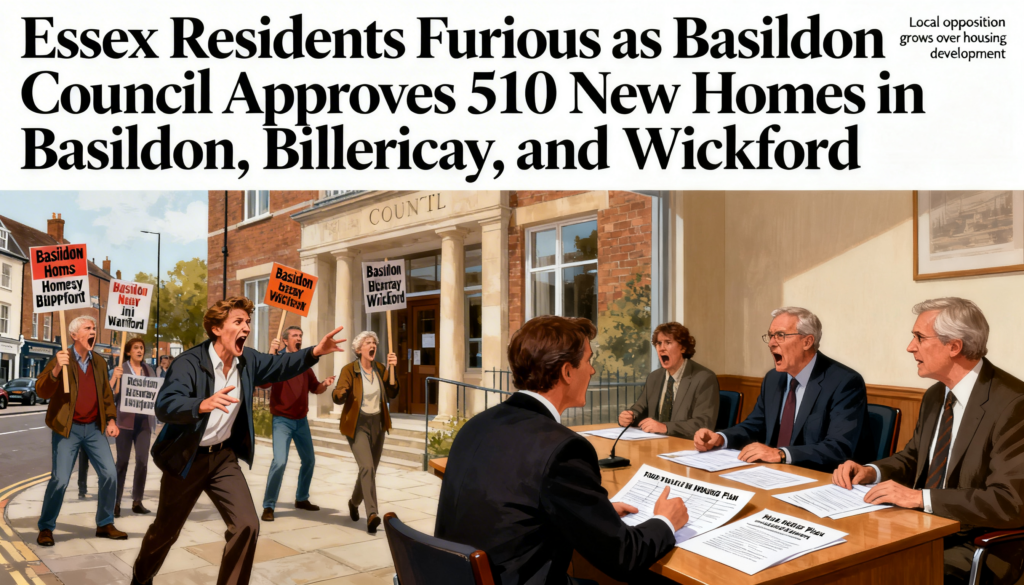
On March 11, 2026, the council’s planning committee convened for an extended five-and-a-half-hour meeting to consider multiple applications. The approved developments included approximately 300 homes near Wash Road in Noak Bridge (near Basildon), 117 homes at Bell Farm in Wickford, and four homes near Ballards Walk in Basildon. While a proposal for 40 homes in Bells Hill Road, Vange, was refused and another for 49 homes near Potash Road in Billericay was deferred, the majority of the schemes proceeded despite substantial opposition. Residents attending the meeting described feeling “silenced,” with claims that community voices were not adequately considered during deliberations.
Resident objections have centered on several key issues. Many argue that the developments will exacerbate existing pressures on local infrastructure, including roads, schools, healthcare services, and utilities. Concerns about the erosion of green belt land and open spaces have also been prominent, particularly in semi-rural areas around Billericay and Wickford. Critics contend that the scale of building fails to align with sustainable growth and could lead to increased traffic congestion and reduced quality of life.
The council’s rationale for these approvals stems from pressing housing targets established by national government policy. Basildon Borough is required to meet substantial housing delivery obligations, as outlined in its emerging Local Plan, which proposes approximately 27,000 new homes by 2043 to address identified needs. This includes a significant proportion of affordable housing—around 10,000 units borough-wide in the draft plan—to support local demand and vulnerable residents. Council representatives have emphasized that these developments contribute to fulfilling statutory requirements and providing homes for future generations, while some recent approvals have secured direct council-managed affordable units to prioritize local needs.
Infrastructure strain remains a focal point of contention. Opponents highlight that many sites involve greenfield or green belt releases, with limited brownfield opportunities due to capacity constraints in urban areas. The council has acknowledged the need for accompanying improvements, such as new schools, community facilities, and transport enhancements in broader plan documents, though specific mitigations for individual approvals vary.
Regarding potential appeals or legal challenges, residents and opposition councillors have indicated dissatisfaction with the process, raising the possibility of formal appeals to the Planning Inspectorate or judicial review proceedings where decisions are alleged to breach planning policy or procedural fairness. However, no specific appeals have been confirmed in relation to the March 11 approvals at this stage. The broader Local Plan, currently progressing toward adoption in late 2026, continues to face scrutiny and may attract further challenges during examination.
These developments reflect ongoing tensions between national housing imperatives and local priorities in Essex communities. Residents are encouraged to engage with th
