
The ongoing conflict involving the United States, Israel, and Iran has introduced substantial uncertainty into the United Kingdom’s economic landscape, with particular repercussions for energy costs and borrowing expenses. As of mid-March 2026, this escalation has driven volatility in global energy markets and influenced domestic financial conditions, affecting households and businesses in London more acutely due to the city’s reliance on commuting, high housing costs, and exposure to national inflationary pressures.
Market Reactions
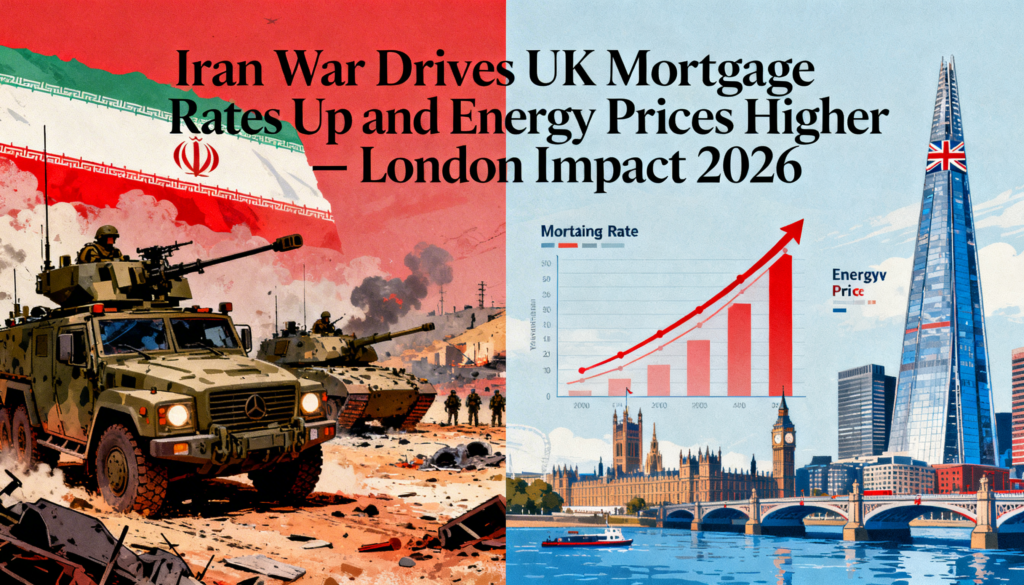
Financial markets have responded swiftly to the conflict. Brent crude oil prices have exhibited significant volatility, surging initially and stabilizing around elevated levels (approximately $80–$103 per barrel in recent trading), driven by disruptions in the Strait of Hormuz and broader supply concerns. This has translated into higher wholesale gas and electricity prices in the UK, with gas contracts rising substantially (e.g., summer 2026 contracts up around 50–70% in short-term movements). The FTSE 100 experienced notable declines in early March, reflecting investor concerns over prolonged geopolitical risks. Bond yields and swap rates have increased, signaling expectations of persistent inflation and delayed monetary easing by the Bank of England.
OBR Forecasts
The Office for Budget Responsibility (OBR) published its March 2026 Economic and Fiscal Outlook prior to the conflict’s full escalation but included a cautionary note on potential “very significant impacts” from Middle East developments, particularly on energy markets. The central forecast projected UK GDP growth slowing to 1.1% in 2026 (down from a prior 1.4% estimate), with inflation expected to reach the 2% target by late 2026 under baseline assumptions. However, OBR representatives, including Professor David Miles, have since warned that sustained energy price spikes could add approximately 1 percentage point to consumer prices by year-end, potentially pushing inflation toward 3%. Growth could face further downward pressure (e.g., reductions of 0.2% or more in some estimates), while unemployment may rise modestly.
Energy Supply Risks and Price Impacts
The conflict poses direct risks to global energy supply chains, given Iran’s role in oil production and the Strait of Hormuz’s critical position for approximately 20% of world oil and gas flows. Disruptions have led to halted shipments, production curtailments, and insurance challenges for tankers. In the UK, a net importer heavily reliant on gas for electricity (around 30%) and home heating (over 70%), this has manifested in sharp rises: petrol prices reached 18-month highs (around 140–150p per litre possible if sustained), diesel increased notably, and wholesale gas prices surged 50–70%. Household energy bills face upward pressure when the price cap is reviewed (e.g., potential impacts from July 2026 onward). The British Chambers of Commerce and others anticipate elevated inflation throughout 2026 due to these dynamics.
London-Specific Effects
London households and businesses experience amplified effects from these national trends. High commuting dependency means rising petrol and diesel costs directly increase transport expenses for millions. The capital’s elevated housing market—characterized by substantial mortgage debt and remortgaging activity—faces challenges from rising borrowing costs, potentially reducing affordability and transaction volumes. Energy-intensive sectors, including retail, hospitality, and office-based services, confront higher operational expenses, which may constrain investment or lead to price pass-throughs affecting consumers. Consumer sentiment in the UK has deteriorated markedly, with households expressing heightened caution about major purchases amid war-related worries.
Expert Commentary
Economists and analysts have highlighted the inflationary risks from energy shocks, drawing parallels to prior crises (e.g., the 2022 Russia-Ukraine conflict). Think tanks such as Chatham House note that while short-term oil price spikes may moderate, prolonged disruption could add modestly to European and UK inflation (around 0.5 percentage points in some scenarios). Mortgage experts and financial commentators emphasize that lenders have responded to higher swap rates and delayed Bank of England cuts by increasing fixed-rate deals and withdrawing products. Warnings from institutions like the National Institute of Economic and Social Research underscore potential hits to growth and investment.
Government Responses
Prime Minister Keir Starmer and Chancellor Rachel Reeves have acknowledged the risks, stating that the government is monitoring developments closely and engaging international partners to mitigate impacts (e.g., discussions on releasing emergency oil reserves). The administration has emphasized economic resilience and preparedness for price shocks, while avoiding immediate interventions such as extending energy bill caps (which could prove costly). The Spring Statement in early March underscored stability efforts amid uncertainty, though forecasts predate the conflict’s intensification.
In summary, the conflict exacerbates existing pressures on the UK economy, with rising mortgage rates (average two-year fixed deals now around 5.20%, up from pre-conflict levels) and energy costs posing direct challenges for London residents and enterprises. Sustained escalation would likely prolong these effects, while de-escalation could allow partial recovery in market conditions.
