
A sophisticated drug trafficking network smuggled nearly £10 million worth of cocaine into Britain with the assistance of an alleged insider at a major UPS depot in Essex, a court has heard.
Prosecutors at Southwark Crown Court in London told jurors that the operation involved the covert importation of approximately 300 parcels of class A drugs over a five-week period between mid-April and late May 2020. The packages were dispatched from the Netherlands and routed directly to the UPS facility in Stanford-le-Hope, where they were addressed to a single semi-detached property in Upminster on the Essex-London border.
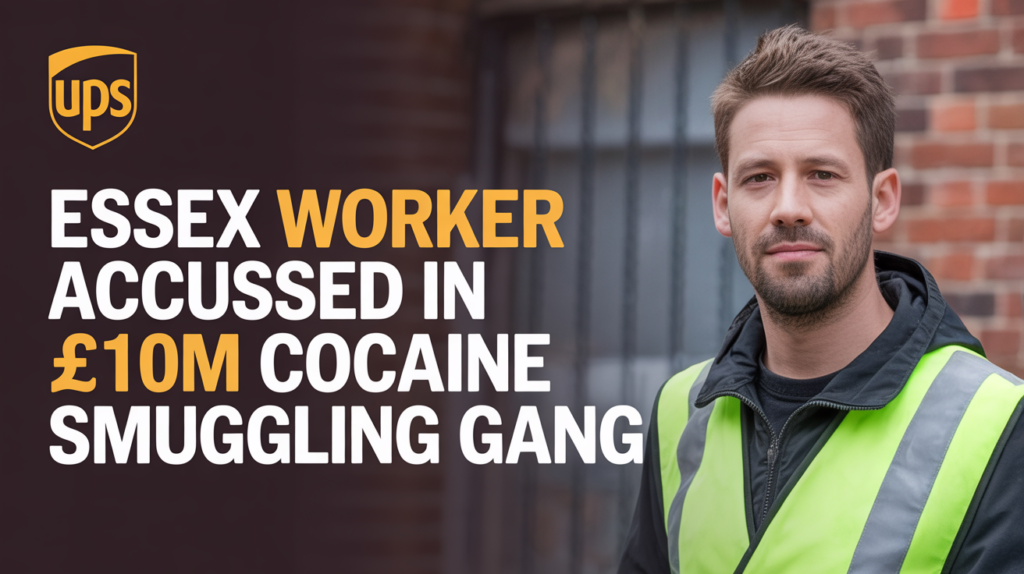
Zak Archbold, 30, from Braintree, Essex, stands accused of playing a central role in the conspiracy. As pre-load team leader at the Stanford-le-Hope depot, Archbold is alleged to have exploited his supervisory position to identify incoming parcels and ensure their safe onward loading onto delivery vans. The prosecution claims he was known within the gang by the codename “King” and received payments of £750 for every kilogram successfully imported.
EncroChat messages recovered by police investigators provided the backbone of the case. Gang members, operating under aliases including “Ghost”, “Veggie Kray” and “Cuddly Bandit”, exchanged references to “UPS going well” and conducted “dry runs” to test the route. The network reportedly paid around £2,000 per kilogram for the cocaine, highlighting the scale and professionalism of the enterprise. Prosecutor Jenny Burgess told the jury: “This is a case about drug trafficking and the importation of cocaine into the UK through UPS, an international parcel delivery company.” She added that Archbold was “running the show” at the depot and used his role “to facilitate the safe passage of parcels to the drivers for onward delivery”.
Archbold denies the charges of conspiracy to fraudulently evade the prohibition on the importation of a controlled drug of class A between January and July 2020. He maintains he is not the individual referred to as “King” in the encrypted communications. During the trial, the court heard that the scheme came to light after suspicions arose concerning a separate UPS delivery driver who was alleged to have stolen cash payments from customers collecting parcels. When interviewed internally by UPS, Archbold acknowledged awareness of the cash theft but insisted he had no knowledge of any drug-related activity involving the same driver.
The investigation has already yielded partial results. One conspirator, Steven Bullen, has pleaded guilty to his part in the operation. However, three other accused individuals—Benjamin Thake, Craig Merrin and Jurre Faber—remain at large, according to prosecution statements. Archbold’s trial continues, with the jury expected to consider the attribution of the “King” alias and the extent of his alleged involvement.
This case illustrates a growing trend in which organised criminal networks exploit legitimate logistics channels for high-volume drug importation. The parcels, once cleared through the Stanford-le-Hope facility, were collected and distributed further into the UK supply chain. Such importations frequently feed into the county lines model, a sophisticated distribution system employed by urban gangs to supply cocaine and other class A drugs to provincial towns, coastal communities and rural areas.
County lines operations typically involve the exploitation of vulnerable young people, often children or teenagers, who are recruited to transport drugs across county boundaries using dedicated mobile phones—hence the term “county lines”. Dedicated lines enable rapid, on-demand supply while minimising direct contact between senior gang members and street-level dealers. The £10 million consignment described in court could have generated street-level revenue far exceeding its wholesale value once broken down and adulterated for retail sale across multiple county lines networks operating from London and the South East.
Experts note that the COVID-19 pandemic period, during which the alleged smuggling occurred, saw heightened reliance on parcel delivery services as international travel restrictions disrupted traditional smuggling routes. Criminal groups adapted quickly, using encrypted platforms such as EncroChat to coordinate logistics with precision. The National Crime Agency and regional organised crime units have since intensified efforts to disrupt these hybrid supply chains, combining traditional surveillance with advanced digital forensics.
The implications of successful prosecutions in cases such as this extend beyond immediate seizures. They disrupt not only the importation tier but also the downstream county lines networks that rely on consistent, high-purity supply to maintain market dominance and generate profits estimated in the hundreds of millions annually across the UK. Law enforcement sources emphasise that every intercepted consignment reduces the volume of drugs reaching vulnerable communities and limits the associated harms, including addiction, violence and the exploitation of minors.
As the trial at Southwark Crown Court proceeds, the proceedings serve as a reminder of the evolving tactics employed by transnational drug gangs. The alleged abuse of a trusted position within a global logistics company underscores the challenges faced by both private industry and authorities in safeguarding supply chains against criminal infiltration. Authorities continue to monitor similar vulnerabilities, with ongoing operations aimed at dismantling the networks that sustain Britain’s illicit drug market.
The outcome of Archbold’s case, together with efforts to apprehend the remaining suspects, will provide further insight into the resilience of these sophisticated criminal enterprises and the effectiveness of current counter-narcotics strategies. For now, the jury must weigh the evidence presented and determine whether the UPS supervisor was indeed the “King” who enabled one of the most audacious parcel-based cocaine importations in recent memory.
