
Who Were Violinski?
Violinski were an English art-rock group active from the late 1970s through to the mid-1980s. The project was founded by two former members of the legendary Electric Light Orchestra (ELO): violinist Mik Kaminski and guitarist/bassist/vocalist Mike de Albuquerque. The name itself was a clever bit of wordplay — a fusion of Kaminski’s surname with “violin,” perfectly capturing the essence of a project built around the electric violin.
Despite a relatively brief existence, Violinski left a notable mark on British music history, chiefly thanks to their instrumental single “Clog Dance,” which stormed the UK Singles Chart in 1979, peaking at number 17 and forever securing the band’s status as a beloved one-hit wonder — one hit, but what a hit.
The Backstory: From Student Band Cow to ELO and Back Again
The roots of Violinski stretch back to the late 1960s. Mik Kaminski, born in Harrogate, North Riding of Yorkshire, began his professional career remarkably early — he gave his first concert with the Leeds Orchestra at just 14 years of age. Whilst studying at the Leeds School of Music between 1968 and 1970, he and his mates — drummer John Hodgson and keyboardist John Marcangelo — founded a band called Cow. This trio would later form the backbone of Violinski.
Their paths temporarily diverged. In 1973, Kaminski answered an advert in Melody Maker for the vacant violinist post in ELO. He auditioned before bandleader Jeff Lynne and was recruited — reportedly the only candidate who didn’t play a single bum note. With ELO, Kaminski recorded several iconic albums, including On the Third Day, Face the Music, A New World Record and Out of the Blue, and cultivated his trademark image: a blue electric violin that became his calling card on stages across the world.
Mike de Albuquerque, born in Wimbledon, joined ELO in 1972 as bassist and backing vocalist, featuring on ELO 2 and On the Third Day. He departed the group in 1974 for domestic reasons and was replaced by Kelly Groucutt. After leaving, de Albuquerque released two solo albums and collaborated with various musicians, but the idea of reuniting with Kaminski never quite left him.
The Birth of Violinski: 1977–1979
Violinski grew out of a group called The Camden Rats, which featured Kaminski, Hodgson and guitarist Geoff Crampton. Kaminski and Hodgson then brought in their old Cow bandmate Marcangelo. The original line-up was completed by Andy Brown (bass, vocals) and Baz Dunnery (guitar).
The first recording session took place on 14 December 1977. Work on the debut album continued throughout 1978, during which the line-up shifted: Brown and Dunnery were replaced by Mike de Albuquerque (guitar, vocals) and Paul Mann (bass, vocals). The group recorded for Jet Records — the very same label that released ELO’s records.
The line-up for the debut album:
- Mik Kaminski — violin
- Mike de Albuquerque — guitar, vocals
- John Hodgson — drums
- John Marcangelo — keyboards
- Paul Mann — bass, vocals
Clog Dance: The Hit That Conquered Britain
In January 1979, Violinski released their debut single, “Clog Dance” — an instrumental composition penned by John Marcangelo. According to the songwriter, his inspiration came from a shop called Brew’s in his home town, which sold wooden clogs.
The track caught fire almost instantly when BBC Radio 1 adopted it as the backing music for their weekly Top 40 countdown. This ensured the single a place in the top twenty: “Clog Dance” reached number 17 on the UK Singles Chart in March 1979 and also became a significant hit in the Netherlands.
The buoyant, irresistibly joyful melody — led by Kaminski’s soaring violin — proved to have extraordinary staying power. Its afterlife is genuinely remarkable:
Film. The tune featured prominently in Brassed Off (1996), the much-loved British film starring Ewan McGregor and Tara Fitzgerald about a struggling colliery brass band in Yorkshire. The melody accompanies the band’s triumphant bus journey to the National Finals at the Royal Albert Hall. This brought “Clog Dance” to an entirely new generation of listeners.
Motorsport. “Clog Dance” became the official theme tune for the Ministox racing formula on many of the UK’s short oval car racing circuits — a connection that endures to this day.
Television. The track was used as the backing for several games in Banzai, the Channel 4 spoof Japanese game show that aired in the early 2000s.
Brass bands. The composition became a firm favourite amongst brass bands across the country and continues to be performed at competitions and festivals up and down Britain.
Musical theatre. In 2007, Marcangelo himself wrote Clog Dance the Musical, which premiered at Whitehaven Civic Hall.
Discography: Two Albums and a Long-Lost Compilation
No Cause for Alarm (1979)
Violinski’s debut album was released in the spring of 1979 on Jet Records and reached number 49 on the UK Albums Chart. Following the success of the instrumental “Clog Dance,” critics were rather perplexed to discover that the album contained vocal tracks — the band had already been pigeonholed as a purely instrumental act. The follow-up single “Save Me,” which featured vocals, failed to replicate the commercial success of “Clog Dance,” and media interest began to wane.
The album was reissued in the United States under the title Whirling Dervish in 1982.
Stop Cloning About (1980)
For their second album, Paul Mann on bass was replaced by Iain Whitmore, formerly of Starry Eyed and Laughing. The record showcased a more mature sound but did not achieve commercial success. The band released several further singles, including “Silent Love,” which received radio airplay but never made it into the shops owing to an account problem with Jet Records — a missed opportunity for what could have been a second chart entry.
Clog Dance: The Very Best of Violinski (2007)
This compilation, arriving decades after the band’s demise, proved to be something of a landmark. The original master tapes had been missing for over twenty years before being discovered in an unmarked London tape vault. The collection marked the first time much of Violinski’s catalogue appeared on CD and included previously unreleased material as well as an alternative “rock” version of “Clog Dance.”
Violinski’s material also featured on ELO’s Friends & Relatives compilation.
Life After Violinski
In 1984 and into 1985, the band played a handful of gigs with British guitarist Ronnie Caryl before quietly winding down. But the story didn’t end there for the principal members.
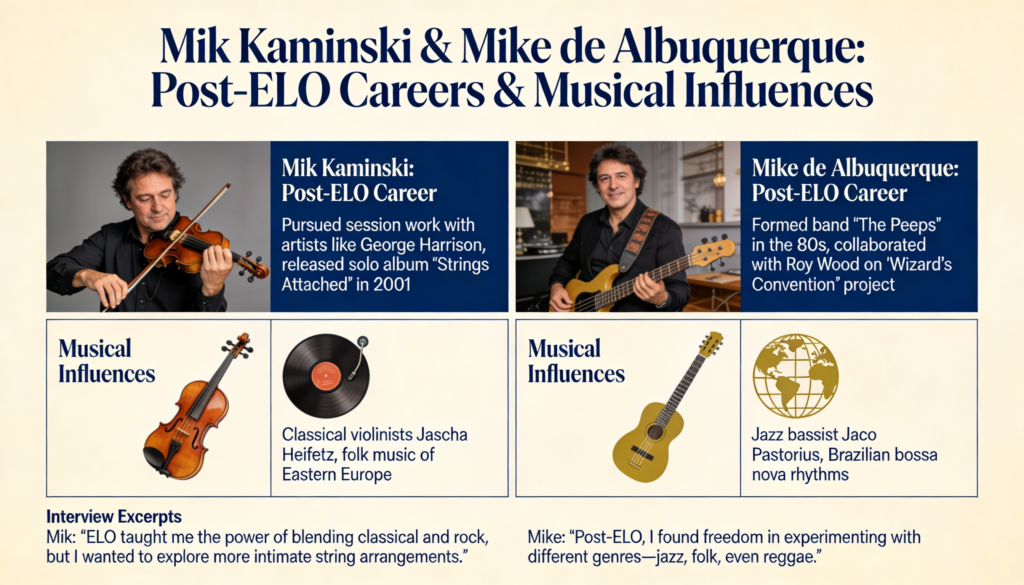
Mik Kaminski
Following Violinski’s dissolution, Kaminski continued his musical career firmly within the ELO orbit. He returned to the fold for touring duties in support of the albums Time and Balance of Power, and played on the 1983 single “Rock ‘n’ Roll Is King.” He subsequently formed the group Player (later renamed OrKestra) alongside ELO bassist Kelly Groucutt.
In 1991, Kaminski joined ELO Part II, and from 2000 became a founding member of The Orchestra — a group that carried on performing the ELO catalogue. In 2026, Kaminski stepped back from touring but continues to contribute to the band in a special advisory capacity. His famous blue violin remains one of the most recognisable images in the history of British rock.
Mike de Albuquerque
After Violinski, de Albuquerque maintained a relatively low profile. In 1982, he founded the band Sundance alongside producer Mike Hurst and singer Mary Hopkin, best known for her hit “Those Were the Days.” In recent years, his 1970s solo albums — We May Be Cattle But We’ve All Got Names and Stalking the Sleeper — have been reissued by Think Like A Key Records, sparking renewed interest in his work. In a recent interview, de Albuquerque spoke warmly of his time with Violinski, praising Hodgson’s electrifying drumming and Marcangelo’s outstanding talent as a composer.
John Hodgson
The former Violinski drummer went on to become head of Boomba-Bomba Records and now works as a percussion teacher in Huddersfield, Yorkshire.
Why Violinski Matter to Music Lovers in Essex
Essex has long been one of the United Kingdom’s foremost musical counties. From Blur and Depeche Mode to Gorillaz (the brainchild of Colchester’s Damon Albarn), Alison Moyet, and Humble Pie, the region has produced artists who’ve shaped the sound of modern Britain. The county’s musical culture has always been defined by a willingness to experiment — from the synth-pop of Basildon to the Britpop of Colchester.
Violinski, for all their Yorkshire pedigree, represent a genre and an ethos that resonates deeply with the experimental spirit of the Essex music scene: the marriage of classical instrumentation with rock energy, the blurring of genre boundaries, the audacity to meld the highbrow with the popular. For Essex music enthusiasts who cherish the legacy of ELO and progressive rock, Violinski are an undervalued chapter of British musical history well worth rediscovering.
What’s more, “Clog Dance” is one of those tunes that everyone knows without knowing its name. If you’ve ever heard that spirited violin melody at the races, on a vintage telly programme, or in a beloved British film — chances are, it was Violinski all along.
At a Glance
| Years active | 1977–1985 |
| Genre | Art-rock, progressive rock, instrumental rock |
| Label | Jet Records |
| Origin | England (members from Yorkshire and London) |
| Biggest hit | “Clog Dance” (1979, UK No. 17) |
| Albums | No Cause for Alarm (1979), Stop Cloning About (1980) |
| ELO connection | Mik Kaminski (violin) and Mike de Albuquerque (guitar/vocals) — both former members of the Electric Light Orchestra |
Violinski are available on Spotify, Apple Music and other streaming platforms. The compilation Clog Dance: The Very Best of Violinski is the ideal starting point for exploring the band’s legacy.
